

What the Heck is Customering?
Based on an extract from the core text: ‘The Customering Method’, Routledge Press, a Division of Taylor & Francis (New York, London), November 2024.
We are often asked if customer management (customering) is an extension of marketing, or an adjunct discipline to it. The answer is both. The core tenets of the marketing method were developed in the wake of the industrial revolution - which gave us market-based economies for the first time – and was first taught at Harvard University in the 1950s.
In the same way that its arrival was borne of changed conditions, so too the arrival of the customering method after the collapse of dyadic service in the digital era. Managing the customer base (the asset) was never a distinct managerial discipline until that time but is now an imperative to de-risk the asset and to optimise company profitability. In doing so, it also improves the unit economics of marketing and so is connected economically.
In Module 8 of the Mini MBA in Customering we examine the three major intersections of customer management and marketing.
EXTRACT COMMENCES
You should now consider two things.
- The functions of marketing are specifically designed to achieve market-level outcomes and have been refined over decades of scholarly investigation and practice. They are not “playthings” to be imported into customer management. They belong where they belong, in marketing.
- The marketing vocation comprises a clear set of management processes and methodologies that require significant knowledge and expertise to execute, which stands in stark contrast to the populist and noisy scattering of CX mantras.
In contrast, the customering method represents the scientifically informed management of the asset, with an acknowledged, technical relationship with the core marketing function.
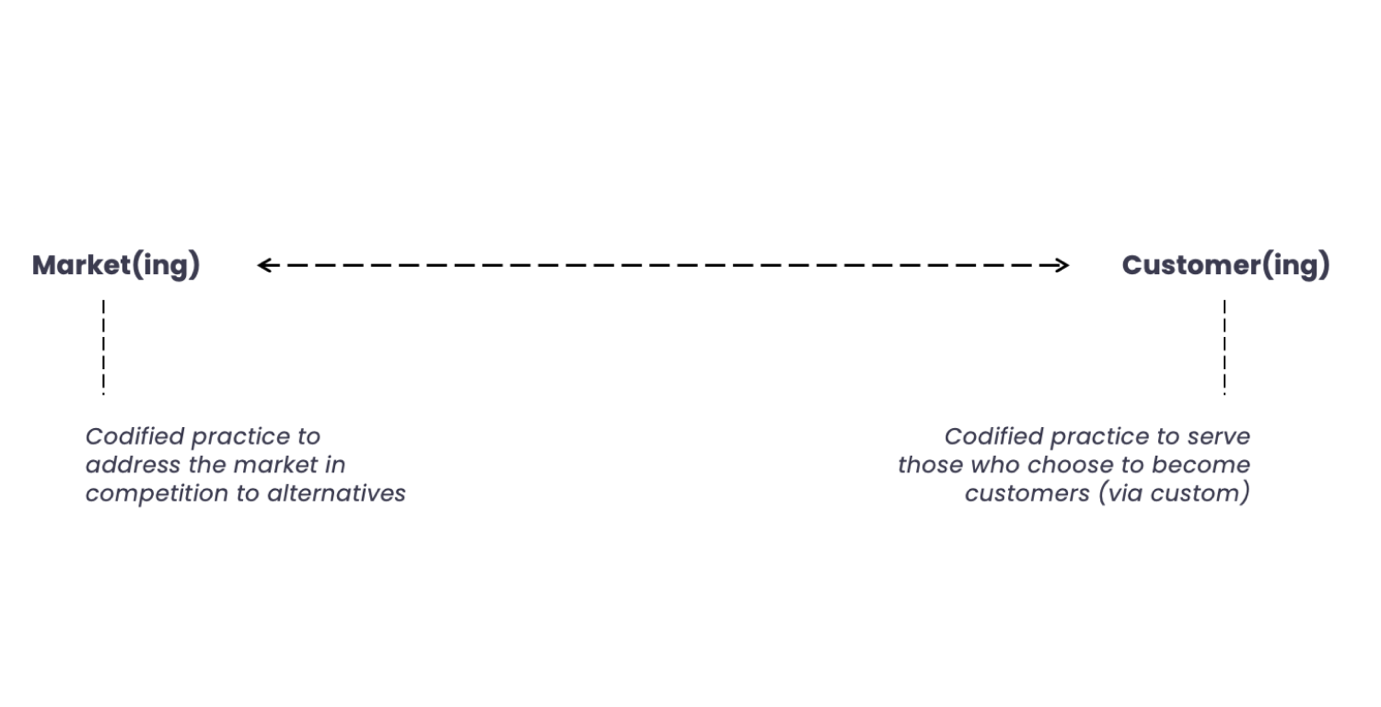
The term “customering”, as I had initially begun to use it in 2015, is simply a shorthand for “customer management” as distinct from marketing. If one side of the proverbial coin is addressing the wider market, the other side is hosting and serving members of that market who have chosen to interact with the company at the present time.
Just as “market” is the root word of marketing, so too is custom, then customer, the root of customering (Figure 1.1):
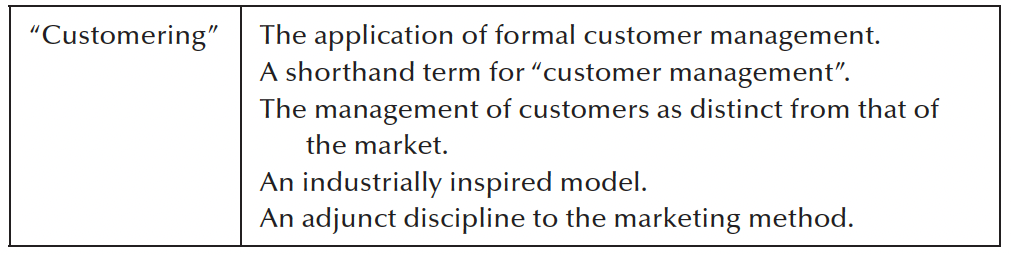
You will find that “individualization” is a core and irreplaceable competency of customering. Of course, individualism has its origins in philosophy, sociology, and political theory. In the customer field, however, and for the avoidance of doubt, refer Table 1.1.
You will find the major component parts expressed as industrial discipline, a strident bias to service, an orientation to the individual (not to markets or segments), and, finally, the periodic select use of experiential tactics (Figure 1.2).

Many will note the narrow use of experiences. Don’t misinterpret this; they are both disproportionately powerful and necessary. But they are akin to a drug and, contrary to the common refrain, we must use them under careful and qualified prescription, and as remedy to target needs or ambition only.
In module 6 of the Mini MBA in Customering we explore the economic and neurological distinctions of human experience, finding, that the use of the word as a catchall term for all forms of customer interaction is a deeply flawed practice. You should also note that experiential treatments are hobbled without an unequivocal foundation of service.
Welcome to customering: both an extension of, and adjunct discipline to, marketing.
.png)
.png)
Join the next intake and start learning