

How the Education System Failed Customer Leaders
From marketing technology teams, to contact centre operations and retailers, and from marketers to those who work under moniker of ‘customer experience’, the absence of specialist higher education in the administration of the corporate customer base is now manifest in losses, which cumulative studies show to exceed 10 trillion USD.
Naturally, that starts to get the attention of responsible company directors and their executive. The question becomes:
To what extent do we contribute to those statistics?
The customer base is of course, the most valuable strategic asset of any business. In fact, it is a distinct economic asset, defined by scientifically discovered characteristics. The job of customer management (customering), then, is to manage and or disrupt those patterns in the company’s interest.
Naturally, this takes expertise in the asset itself, then the system of management, and finally, its systems enquiry (measurement).
Companies require managers and related technologists across the customer related fields, who possess that expertise. It is the absence of that expertise, that sits behind the corporate loss. So, the short answer to our question, is that without that knowledge in a business, it is a forgone conclusion that, yes, it will be contributing. Which raises another obvious question.
Why is that we don’t teach customer management as a critical part of higher education?
The Education Gap
After the industrial revolution concluded in 1840, which gave us market-based economies, formal training in marketing as a codified discipline, did not arrive until the 1950s at Harvard -over a century later. As a comparison, the collapse of dyadic service owing to the fragmentation of customer interactions, requiring the hands-on management of the customer base as an asset, is a largely an occurrence of the 21st century.
And so, the absence of universal higher education, around a quarter of a century into that shift, is perhaps not surprising. The programs of Field Bell Institute mark an important milestone, but in of itself, does not represent a wholesale response by the higher education sector.
Also playing a role in the slowness of organisations to improve their literacy, despite the documented corporate loss, is that many involved in the field do not perceive, or publicly acknowledge, their own educational gap.
Nevertheless, our 2023 study found that 90% of respondents reported that “advanced formal training in customer management would improve the industry and their career”.
In the meantime, countless thousands promote careers based on little more than ‘badges from technology vendors. Others rely on association courseware, which don’t rise to anywhere near the pedagogical standard of professional training. Neither are independently accredited.
In our review, we even found associations that claim to “certify” their own courses, or third parties to teach their them. Some try to obfuscate the matter. In response to questions on the standing of their offered qualifications, one states:
“Our courses are created by marketing professionals, meaning we are industry recognised”.
Failed Academic and Industry Partnerships
Compounding matters, otherwise respected business schools and universities have responded to increasing demand with similar commodity micro-courses and certificates, often taught on contract by vendors, or by consultants with those vendor or association certificates.
This has consigned the customer field to a range of courses that fail to provide substantive education - as denoted on the orange box in figure 1.0
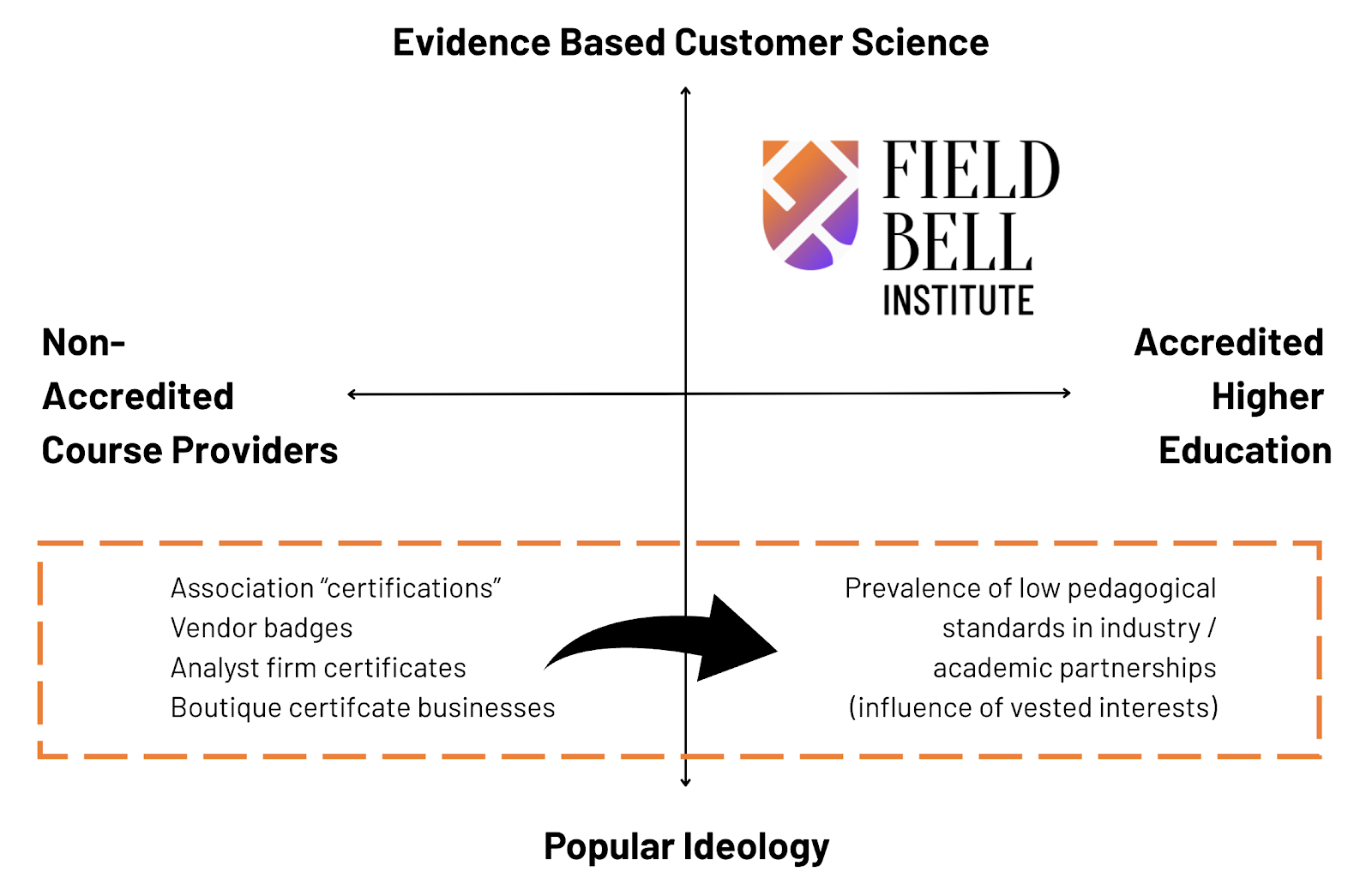
While students gain a certificate with a great brand school, they do not gain a relevant education, and offered credential itself, is not often accredited by an independent body.
One university takes irony to new levels, by offering a ‘master of science in customer experience management’. Had the relevant science been applied, it would have known that it is impossible to manage human experience.
This is a sharp example of the material failure of these partnerships when the academic institution abdicates its pedagogical responsibility to vested interest. Case in point: the term ‘experience management’ is a sales slogan made popular by a software category. It is not, quite obviously, a form of management and it is certainly not a field of science.
They are not alone, however. Other less obvious errors of academic / industry partnerships abound.
The Implication for Learning and Development
This general failure has left corporate learning and development (L&D) teams high and dry as they try to find more serious training for their affected people. We write about the challenges of learning and development in another research article.
The Mini MBA programs at Field Bell have been designed for working individuals and for all corporate teams working across the customer domain.
.png)
.png)
Join the next intake and start learning